
On Thursday night, I had the privilege of attending the world premier of Beowulf in Afghanistan by Laurie Fyffe, and directed by Kate Smith at the GCTC.
This subject matter is close to my heart as I spent some time in Afghanistan supporting the military for six months, and have worked closely with the military for 20 years. After my deployment when I returned to Canada, I heard many war stories, and learned a great deal about the immense challenges that the Canadian Armed Forces (CAF) members faced while assisting the Afghan population with humanitarian efforts while simultaneously defending against, and fighting off the insurgent Taliban.
I’m so happy that I was able to experience this performance, as it was definitely something I can relate to; I enjoyed it on many levels.
The Venue:
GCTC is a beautiful and artistic gem located in the heart of Wellington West. It has two floors which allow access to the large theatre from both the upper or lower seats. There is a bar located on both floors, but it seems like the second floor is where the cool kids hang out before, after, and between acts; it seems to be the place to gather with your friends and mingle. The theatre itself is very roomy and comfortable with no bad seat in the house. It’s small enough to provide an intimate atmosphere, but not so small so that it feels hokey or low-budget. It really is the perfect size for intimate productions that maintain a high quality. The only challenge with this venue is that there’s no parking, so give yourself an extra 5-10 minutes to find street parking.
The Show:
Beowulf in Afghanistan takes place in the midst of the most recent Afghanistan war during Operation Enduring Freedom, and is centered around the story of a Canadian junior officer and his experiences leading up to and including a multiple IED attack on his convoy. While maintaining a standard defensive posture after the initial attack, an explosion throws him into the air and upon landing, he loses consciousness. Despite his injuries, he is able to stay alive, seemingly thanks to inspiration drawn from a book he studied in university called Beowulf. Throughout the first act, he transitions between a conscious and unconscious state, and when unconscious, he converses with an old university professor. They discuss the details of the Beowulf story, making a direct comparison to the current Afghan war and his situation: him laying wounded in the desert. Throughout this scene, the dialogue alternates between the original Beowulf and the soldier’s current mission.
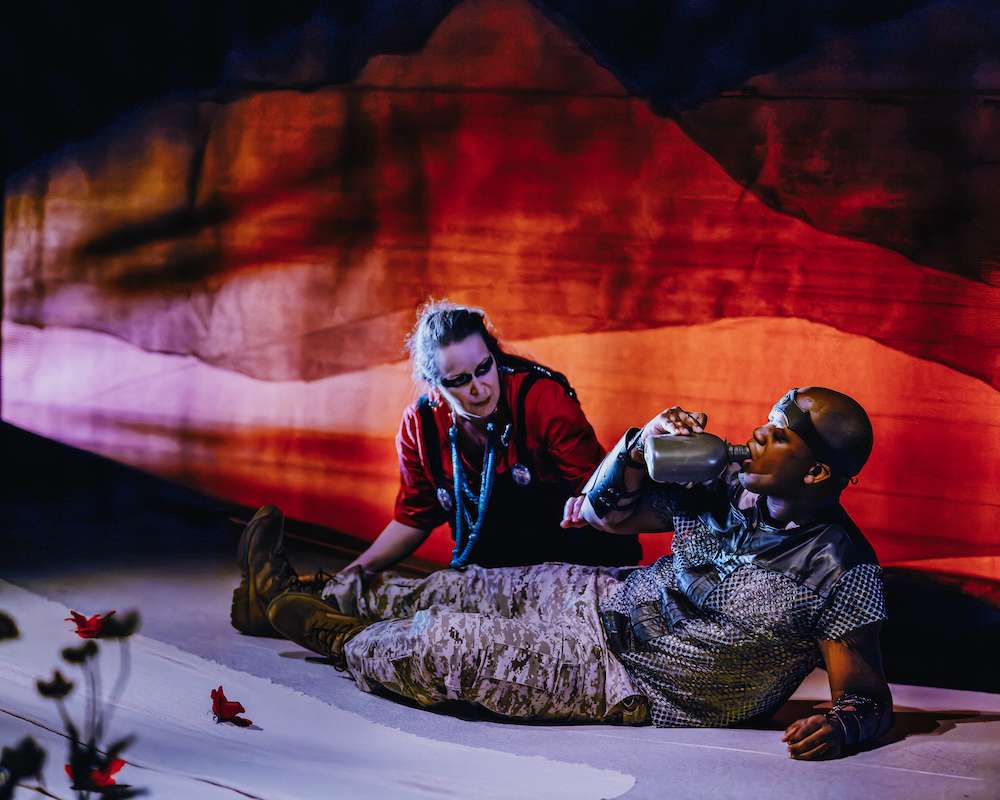
The second half of the show jumps forward in time to a period after the war. The soldier is now a professor at the same university he previously attended. He meets his old professor as she is being “forcibly retired” from her job after several decades of teaching. They discuss the Beowulf story, analyzing various aspects in great detail.
Overall, I really enjoyed the show. However, I found the first half to be much more engaging than the second. In the second act, the storyline shifts from the Afghanistan war to an academic conversation about Beowulf between the professor and her former student. The second half felt like a 45-minute book report. I feel as though it lost all of the emotion and thrill that the first half had and was a bit of a downer (not suggesting the first half was a happy story, but it was much more engaging and emotional). Both acts in this show rely almost entirely on the well-scripted, continuous dialogue between the two characters. These discussions are incredibly deep, particularly the commentary about the war-time aspects of both the original Beowulf era and the Afghanistan war. Both performers are very strong and did an excellent job engaging with each other in the back-and-forth dialogue. This is no doubt a difficult script to memorize, particularly the old English poetry. It is very impressive!!
Stand-Out Performances
This production only had two cast members, so I wasn’t sure if I would include this section, but there are other aspects of the production that deserve a shout-out.
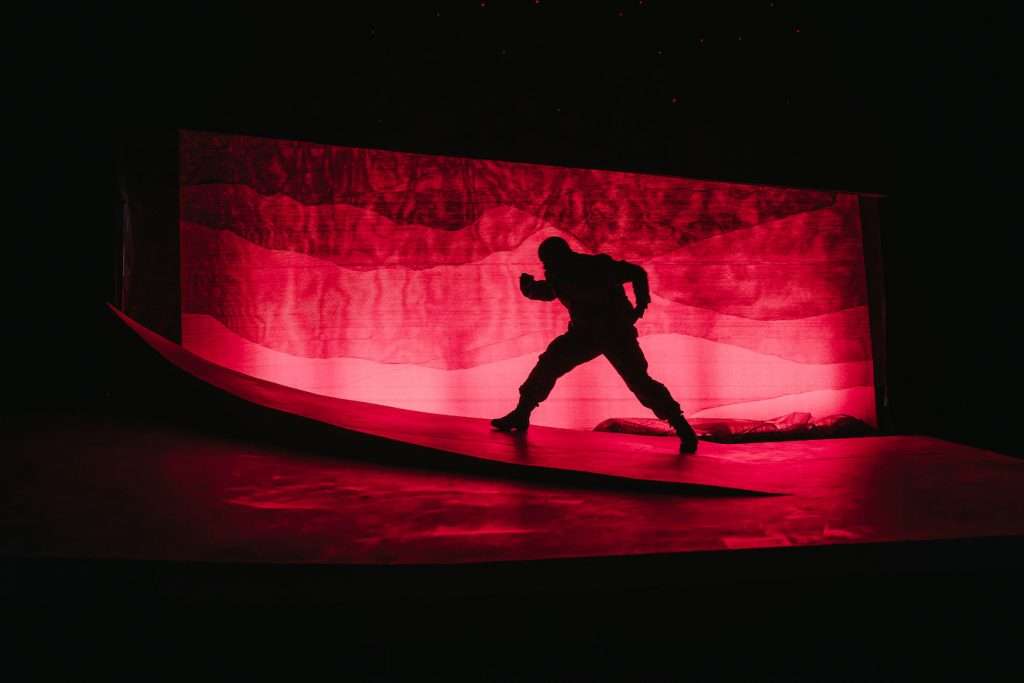
That aspect is definitely the work of Martin Conboy and his lighting design. This is with certainty some of the best lighting effects I’ve seen in local theatre. During the first act, I absolutely loved the use of the floor-level lighting to create silhouettes of the cast. This ingenious design, combined with perfectly choreographed movements, made a wonderfully artistic contribution to the performance, and really added another level to the complexity of emotion in the scene. There are also some incredibly realistic images and flashes on the stage depicting close up or distant explosions and gunfire. It was very well done. Hats off to the designer and operator of the lighting.
My stand-out performance was the lead character, Grant Cleary, (Micah Jondel DeShazer). He is absolutely perfect in this role. He portrays a member of the CAF so realistically it is though he himself has served in a military career, even demonstrating a thorough knowledge of military doctrine. Additionally, he is brilliant in his ability to navigate through the impressive range of emotions in the show. Notably, I found his ability to accurately adapt his limp and level of suffering through different scenes to be remarkable. I think being able to adjust the limp appropriately without missing a beat during conversations with complex dialogue is a feat on its own. It seems like a small point, but it’s the little things that that make a good performance great! His delivery of the dialogue is incredible and seamless when switching topics and situations, even when speaking in old English when quoting from Beowulf. To compliment his impressive delivery, his acting ability is equally impressive. Transitioning from a badly wounded, water-starved soldier laying in the desert after a battle to a physically healthy man discussing war with his former professor was perfect. Everything about DeShazer’s performance was perfect, and he really made this show the success that it is.
I like the GCTC, as they focus on the skills of the individual performers and often put a spotlight on the simplicity of their space. The props and costumes were simple, but excellent. They didn’t have to fill the stage with complex moving parts and elaborate props; they relied on simple, yet appropriate elements to bring the production together. The versatile floor worked well both as a sand dune in the first act, and thanks to some creative furniture design/modifications, an effective office space in the second. As for the costumes, I enjoyed the accurate use of the mix of the Arid CADPAT design for the uniform, and the Temperate Woodland CADPAT for the tac-vest. Reality agrees that the CAF didn’t have time to get the tac-vests, or much of their other wearables produced in matching Arid CADPAT before deploying. Well done on that design!
As a final thought and perhaps a caution to some: I think it’s worth mentioning that potential audience members should be forewarned that some of the depictions of the Taliban attack, including sounds, flashing lights, and the verbal recollection of the attack and the situation leading up to it, may be triggering for some. I would caution that if you suffer from PTSD, or experience other mental health problems related to a combat mission, this may not be the show for you.
Beowulf in Afghanistan kicked off on November 14th, and is running Tuesday to Friday until November 24th. Tickets are available through the GCTC box office or online. There are different options for the show features and pricing, and all the details can be found through the links in this post, or directly on the GCTC website.
